
Biotech + IPO Architect: A New Entrepreneurial Paradigm in the AI Era
Traditional drug discovery models are no longer sufficient for today’s complexities. The AI era demands a new archetype: the Industry + IPO Architect. Transcending the roles of traditional CFOs or consultants, this model uses “Exit-by-Design” to bridge science and capital.
Part 1: Basic Information & Logistics
Join us in person if possible! We also provide a Zoom option for remote attendees. The Zoom link will be sent via email after registration.
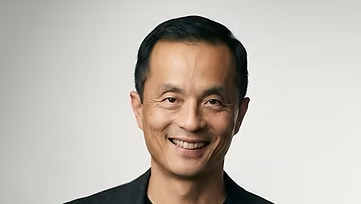
Featured Speaker: Dr. Tao Ke – AI Pioneer & Global Strategy Expert Dr. Ke is a veteran strategist in the AI field with 26 years of hands-on experience in global strategy, M&A, financing, and AI business models. He is a premier consultant for corporate globalization and capital operations. Having entered the industry during the early “AI winters,” he has remained deeply committed to the field ever since.
-
Academic Background: Dr. Ke earned his Ph.D. in Computational Biochemistry from MIT in 1998. He is a pioneer in integrating AI and data analytics with industrial upgrading.
-
Professional Track Record: He has held core management roles at top-tier consulting firms, including McKinsey, Bain, and Accenture, where he was deeply involved in strategic planning, technological innovation, and M&A integration for global enterprises. In recent years, he has empowered multiple companies in the AI and SaaS sectors to achieve exponential growth and has been a key driver in the capitalization of Chinese tech firms in North America.
-
Current Focus: Based in San Diego, Dr. Ke focuses on helping entrepreneurs fundamentally restructure their global AI blueprints. Combining elite consulting and investment expertise, he promotes the seamless fusion of AI technology with industry to accelerate global expansion.
Part 2: Project Agenda & Content
Section I: Exploring the Biopharma “Foundry” Platform—From Lab to Industrialization
(Duration: 60 mins | Weight: 60%)
-
Startup Background: Why “Scientific Breakthroughs” Struggle to Become “Industrial Capabilities”
-
The Reality: Innovation in biopharma has long relied on animal testing, which often fails in human trials due to species differences. With a clinical failure rate near 90%, the cost of developing a single innovative drug has soared to billions.
-
Regulatory Shifts: The FDA Modernization Act 3.0 now allows “non-animal pathways” (e.g., human-derived models, in-vitro systems) as alternatives. This shift is driven by policy opening doors for new methodologies.
-
The Gap: While “Proof of Concept” models exist in labs, the market lacks industrial-grade production capacity that is stable, scalable, and reproducible.
-
-
Strategic Path: Building “Infrastructure” instead of “Drugs”
-
A Deliberate Choice: The team decided early on to focus on providing underlying manufacturing and experimental platforms, avoiding direct competition with potential clients.
-
The “Foundry” Model: Much like semiconductor foundries, this platform aims to provide consistent, reliable experimental foundations to reduce R&D uncertainty.
-
Manufacturing Over Concept: The primary challenge was not just “feasibility” but transforming labor-intensive processes into automated, standardized, and auditable production workflows.
-
-
The Founder’s Role: From Scientist to “System Architect”
-
Organizational Restructuring: Navigating compliance, IP, and cross-border structures to transform from a regional entity into an international, compliant organization.
-
Embedded Collaboration: Moving beyond simple “sales” to co-defining standards with clients, ensuring the platform is naturally embedded into their R&D systems.
-
-
Takeaways for Entrepreneurs: The Value of Infrastructure
-
Instead of betting on a single outcome, build the “tools that help others succeed.”
-
Achieving industrialization and scale is, in itself, an irreplaceable technological barrier and often dictates industry standards.
-
Section II: AI Healthcare Exploration—From “Seeing Data” to “Understanding the Future”
(Duration: 45 mins | Weight: 40%)
-
The New Bottleneck: When Data Becomes “Incomprehensible” to Humans
-
As sensing capabilities improve, the challenge shifts from a lack of data to an inability to identify long-term trends and subtle signals.
-
The Entry Point: Using the retina as a non-invasive, real-time window to observe vascular and neural structures for early risk identification.
-
-
The Pivot: From “Diagnosis” to “Risk Prediction”
-
Moving from answering “What is the problem now?” to “What do these signals mean for the future?”
-
Hardware-Software Integration: Combining algorithms with controlled, real-world physiological data rather than relying solely on public datasets.
-
-
Methodology: Generating Sustainable Value from Data
-
Transforming one-time test results into continuously updated models and services.
-
The Cost of Interdisciplinary Work: The difficulty lies in fostering true collaboration between computer science and biomedicine, requiring patience for “communication failures.”
-
-
Takeaways for Entrepreneurs: Intelligence Beyond Efficiency
-
Data itself is not value; value comes from the ability to interpret uncertainty.
-
Teams that form a closed loop of “Data Generation → Interpretation → Feedback” are more likely to establish long-term advantages.
-
Chinese version:
希望大家线下参加,我们也开通线上zoom,报名后统一发送zoom地址
本次创业项目主讲:
柯涛博士 – AI 先锋与全球战略专家
柯博士,AI 领域的资深战略家,拥有 26 年全球战略、M&A、融资及 AI 商业模式的实操经验,是企业全球化布局和资本运作的顶级顾问。他在 AI 发展的寒冬期便已入行,深耕该领域至今。
学术背景:柯博士 1998 年于 麻省理工学院(MIT)获得计算生物化学博士学位,是融合 AI、数据分析与产业升级的先行者。
职业履历:他曾在麦肯锡、贝恩、埃森哲等顶级咨询公司担任核心管理角色,深度参与全球企业的战略制定、技术创新及并购整合。近年来,他在 AI 及 SaaS 赛道助力多家企业实现跨越式增长,并推动中国科技企业在北美的资本化进程。
现居 San Diego,专注于帮助中国企业家 彻底重构其全球 AI 版图,结合顶级咨询与投资经验,推动 AI 技术与产业的无缝融合,加速企业全球化扩张。
本次创业项目内容:
Agenda
第一部分:从实验室到产业化的生物医药 Foundry 平台探索
(时长:60 分钟 | 权重:60%)
1. 创业背景:为什么“科研突破”很难变成“产业能力”
-
现实问题 在生物医药领域,科研创新长期高度依赖动物实验,但由于物种差异,大量候选药物在进入人体后失败。据行业统计,临床阶段失败率接近 90%,单个创新药的综合研发成本已高达数十亿美元。
-
外部变化 随着《FDA 现代化法案 3.0》的实施,监管层面开始允许使用人源模型、体外系统等“非动物路径”作为补充甚至替代方案。这一变化并不是某项技术突然成熟,而是制度先行,为新方法留出了空间。
-
创业者看到的空白 实验室里并不缺“概念验证”的芯片或模型,但真正缺的是:能够稳定、规模化、可复制地交付,并被药企和监管体系接受的产业级生产能力。
2. 创业路径选择:不做药,而是做“基础能力”
-
一个刻意的选择 团队在早期就做出决定:不进入药物研发本身,而是专注于提供通用、底层的制造与实验平台,避免与潜在客户形成竞争关系。
-
平台化思路 类似半导体产业中的代工厂模式,这个平台的目标是:
-
为不同药企提供一致、可靠的实验基础
-
帮助其在研发阶段降低不确定性,而非替代其创新判断
-
-
制造而非概念 创业过程中,最大的挑战并非“技术是否可行”,而是:
-
能否把高度依赖人工经验的材料和工艺
-
转化为自动化、标准化、可审计的生产流程
这一步往往比科研本身更慢,也更“苦”。
-
-
现实妥协 在商业模式上,通过成熟业务提供现金流,反哺长期投入的新平台建设,是很多硬科技创业绕不开的路径。
3. 创始人角色:从科学家到“系统搭建者”
-
组织与架构调整 创业并不仅是技术问题,还涉及合规、知识产权、跨境结构等现实约束。团队经历了从区域性公司向国际化、合规架构的重组过程。
-
“嵌入式”而非“销售式”合作 与客户的关系不是简单买卖,而是通过共同定义流程、标准和接口,使平台自然嵌入到对方的研发体系中。这种方式推进慢,但粘性高。
-
一个反直觉经验 在高度专业的行业里,被写进对方流程文档,往往比签一份大合同更重要。
4. 给创业者的启示:基础设施的价值
-
启示一 在技术变革早期,与其押注单一成果,不如建设“让更多人成功的工具”。
-
启示二 能够率先完成工业化和规模化,本身就是一种不可替代的技术壁垒,也往往决定了行业标准的走向。
第二部分:从“看见数据”到“理解未来”的 AI 医疗探索
(时长:45 分钟 | 权重:40%)
1. 创业延伸:当数据开始“多到无法被人理解”
-
新的瓶颈 随着实验系统和传感能力提升,生物医学领域并不缺数据,而是缺乏从中识别长期趋势和微弱信号的能力。
-
一个切入点 视网膜作为人体中少数可无创、实时观察血管和神经结构的窗口,为早期风险识别提供了新的可能性。
2. 路径转变:从“诊断结果”到“风险预测”
-
思路变化 传统医疗关注“现在是什么问题”,而创业团队开始尝试回答:这些信号意味着什么趋势?未来可能发生什么?
-
软硬结合的现实优势 相比单纯做算法,结合真实、可控来源的生理数据,使模型训练和验证更贴近真实世界,而不是停留在公开数据集上。
3. 创业者的方法论:让数据产生持续价值
-
从产品到能力 将一次性的检测结果,转化为可持续更新的模型和服务,是团队在探索的方向。
-
跨界的成本 推动计算机科学与生物医学真正协作,远比技术本身更难,需要时间、耐心,以及对“失败沟通”的容忍。
-
长期视角 所谓“数字孪生”,并不是短期落地的产品,而是一种长期积累数据、逐步逼近真实的过程。
4. 给创业者的启示:智能带来的不只是效率
-
启示一 数据本身并不等于价值,价值来自于对不确定性的解释能力。
-
启示二 能够形成“数据产生—理解—再反馈”闭环的团队,更容易建立长期优势。